



Our third consecutive visit to La Biennale di Venezia, and every time Venice gives us more works to fall in love with than we can carry home. From living installations to provocative visions of our future, here are the experiences that stayed with us.
This November we walked again through La Biennale di Venezia: from the pavilions of the Giardini to the long halls of the Arsenale, and on to the palaces, churches and courtyards where the exhibition spreads across the whole city.
And there is something magical about Venice itself. Venice alone is a work of art.
Its canals, bridges, architecture, hidden courtyards, and centuries of history make it one of the most extraordinary places to wander and get lost. You don’t really need another reason to visit.
Contemporary art enters into conversation with a city that has been shaped by art for centuries. Sometimes the contrast is surprising, sometimes provocative, and sometimes unexpectedly beautiful.
A futuristic installation inside a centuries-old building. A performance challenging our understanding of the human body. A digital world questioning what it means to be alive.
That contrast is part of the magic.
More than an art exhibition
A few words for those who never went. La Biennale di Venezia organised its first International Art Exhibition in 1895, and it quickly became one of the most important art shows in the world.
The Biennale brings together six creative disciplines: Art, Architecture, Cinema, Dance, Music, and Theatre, with their own exhibitions, festivals, performances, and programs across the year.
Today the Art Biennale happens every two years, in the even years, and the Architecture Biennale fills the years between.
The 61st edition is called In Minor Keys. It was conceived by Koyo Kouoh, the first African woman to curate Biennale Arte, who passed away in May 2025. Her team and La Biennale decided to realise it exactly as she imagined it: a return to the quiet, sensory and intimate side of art, instead of loud spectacle.
The exhibition opened on 9 May and runs until Sunday 22 November 2026, in the Giardini, the Arsenale and many palaces and churches around the city. Next to the main show there are 100 national participations and 31 collateral events.
A vision close to our hearts
Rather than focusing only on spectacle, the exhibition invites us to explore art through emotion, intimacy, the senses, and our relationships with one another.
It’s a vision that resonates with us at CODAME, the company building ARTEX.
We believe the most interesting creative experiences often happen when disciplines meet. When technology becomes a medium for artistic expression, when science inspires imagination, and when audiences become part of the experience rather than simply observing it.
And below are the most interesting examples from this year’s Biennale.
Our top three: Denmark, Canada, Austria
1. Denmark: Things to Come
Maja Malou Lyse, Curator: Chus Martínez | Danish Pavilion, Giardini


This can be the most provocative of them all. The question on the wall text is simple and strange at the same time: can images change the inner life of our cells? The project starts from a real scientific observation at a Danish sperm bank, and turns the fertility crisis into a story about intimacy, technology and how we live together. Lyse, born in 1993, is the youngest artist ever to represent Denmark in Venice.
The title comes from a 1936 science-fiction film based on H.G. Wells and asks a rather unexpected question:
Could the images we consume actually influence our biology and our future as a species?
The pavilion combines a large-scale video installation, developed with the art collective DIS, with a speculative environment involving fertility rituals, cryogenic technology, and the unusual phenomenon of sperm racing.
Set partly in an imagined sperm bank in 2045, the work uses humor, science fiction, and erotic imagery to explore some very real contemporary anxieties.
It is playful, uncomfortable, absurd, and surprisingly thought-provoking.
What stayed with us is how it challenges the idea that technology exists separately from our bodies.
Perhaps the digital and biological worlds are already far more connected than we imagine.
2. Canada: Entre chien et loup
Abbas Akhavan, Curator: Kim Nguyen | Canadian Pavilion, Giardini
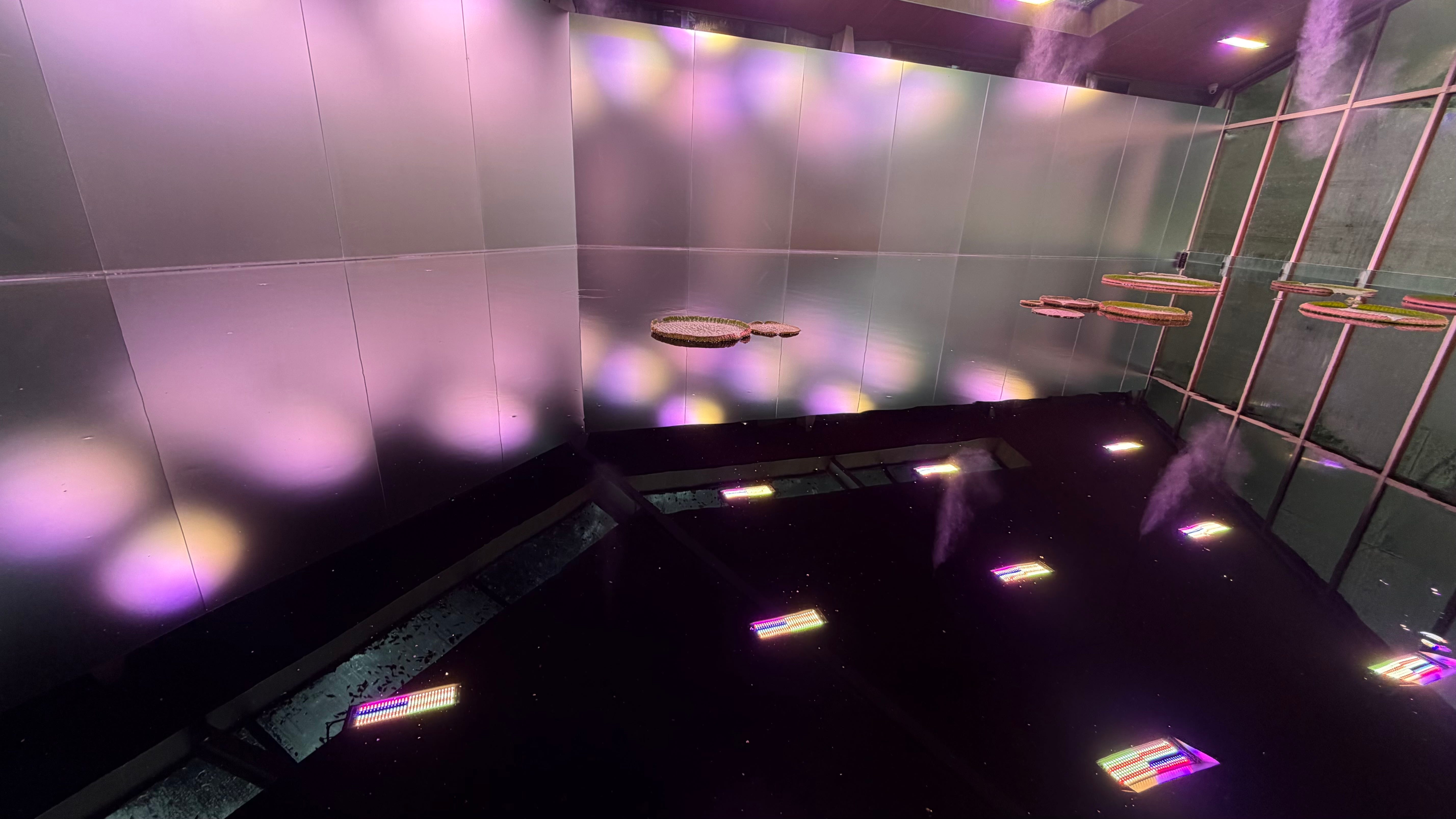
From the intensity of Austria to something almost completely opposite. When you enter, warm and humid air touches your face. Akhavan turned the pavilion into a giant Wardian case, the glass box that the 19th century used to carry plants around the empire. Inside, under pink and violet grow lights, giant Victoria cruziana water lilies float on a dark pool.
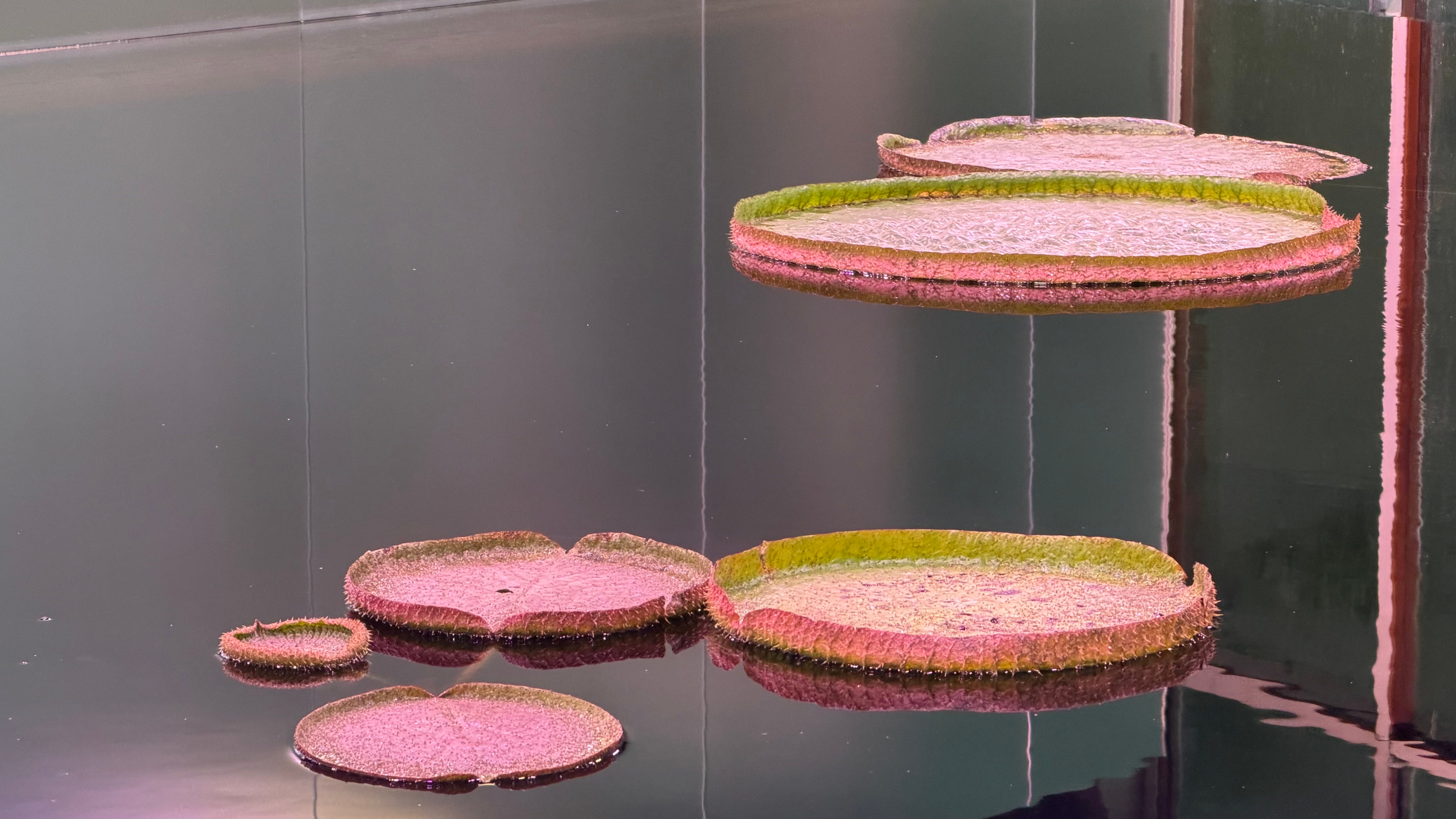
The science behind it is beautiful, quiet, and contemplative. With the Royal Botanic Gardens, Kew, the seeds went to the Orto Botanico di Padova, where they germinated before moving to Venice. The lily family is more than 100 million years old, but its name belongs to a queen. The lilies grow, bloom and fade during the Biennale, so every visitor sees a different garden.
The title means “between dog and wolf”, the twilight moment when shapes blur. It is exactly how this room makes us feel.
3. Austria: Seaworld Venice
Florentina Holzinger, Curator: Nora-Swantje Almes | Austrian Pavilion, Giardini


This is the most talked-about pavilion of the year, and our photo explains why: a long line of umbrellas in the rain, under a bell hanging from a crane. The bell was recovered from the lagoon, and every hour a performer rings it with her own body.
Inside, Holzinger floods the pavilion. A performer rides a jet ski in circles, others hang from a huge turning weathervane, and in the courtyard one performer lives in a water tank for the whole Biennale. That water comes from the visitors’ own toilets, cleaned in a closed system the team built with an Austrian environmental technology company. It is loud, raw, physical and deliberately provocative. It is also a very precise machine about water, tourism and the future of a sinking city. This installation makes you uncomfortable, curious, and unable to look away. And live performers activate the space, turning the pavilion into a continuously evolving experience.So close to the top three…
So close to the top three: Poland, Japan, Australia
Choosing just three wasn’t easy.
A few other experiences left a strong impression.
Poland: Liquid Tongues
Bogna Burska and Daniel Kotowski, Curators: Ewa Chomicka, Jolanta Woszczenko | Poland Pavilion, Giardini
Two big screens, and under the water a choir. In this 30-minute audio-video installation, the Chór w Ruchu (Choir in Motion), with hearing and Deaf performers, interprets the codes and songs of whales. Kotowski is a Deaf artist, and the work asks a quiet question: who does language really belong to? The sound by Aleksandra Gryka does not only reach your ears; you feel it in the body. For us, the video felt surreal. The dancers seem to be under water, but they also seem to float between two underwaters at once. The image has more than one layer, and the whole time we watched, we kept asking ourselves which one was the real picture.

Japan: Grass Babies, Moon Babies
Ei Arakawa-Nash, Curators: Lisa Horikawa, Mizuki Takahashi | Japan Pavilion, Giardini
Babies everywhere: on cushions, in hanging cradles, sitting on wooden structures in the garden. Arakawa-Nash, a queer parent of twins, filled the pavilion with more than 200 baby dolls. Visitors can adopt one, carry it, even change its diaper. The pavilion challenges the traditional idea of the artist working alone, inviting visitors into a shared creative experience.
It is a lovely reminder that art can be playful, human, and collaborative at the same time.
Australia: conference of one’s self
Khaled Sabsabi, Curator: Michael Dagostino | Australia Pavilion, Giardini
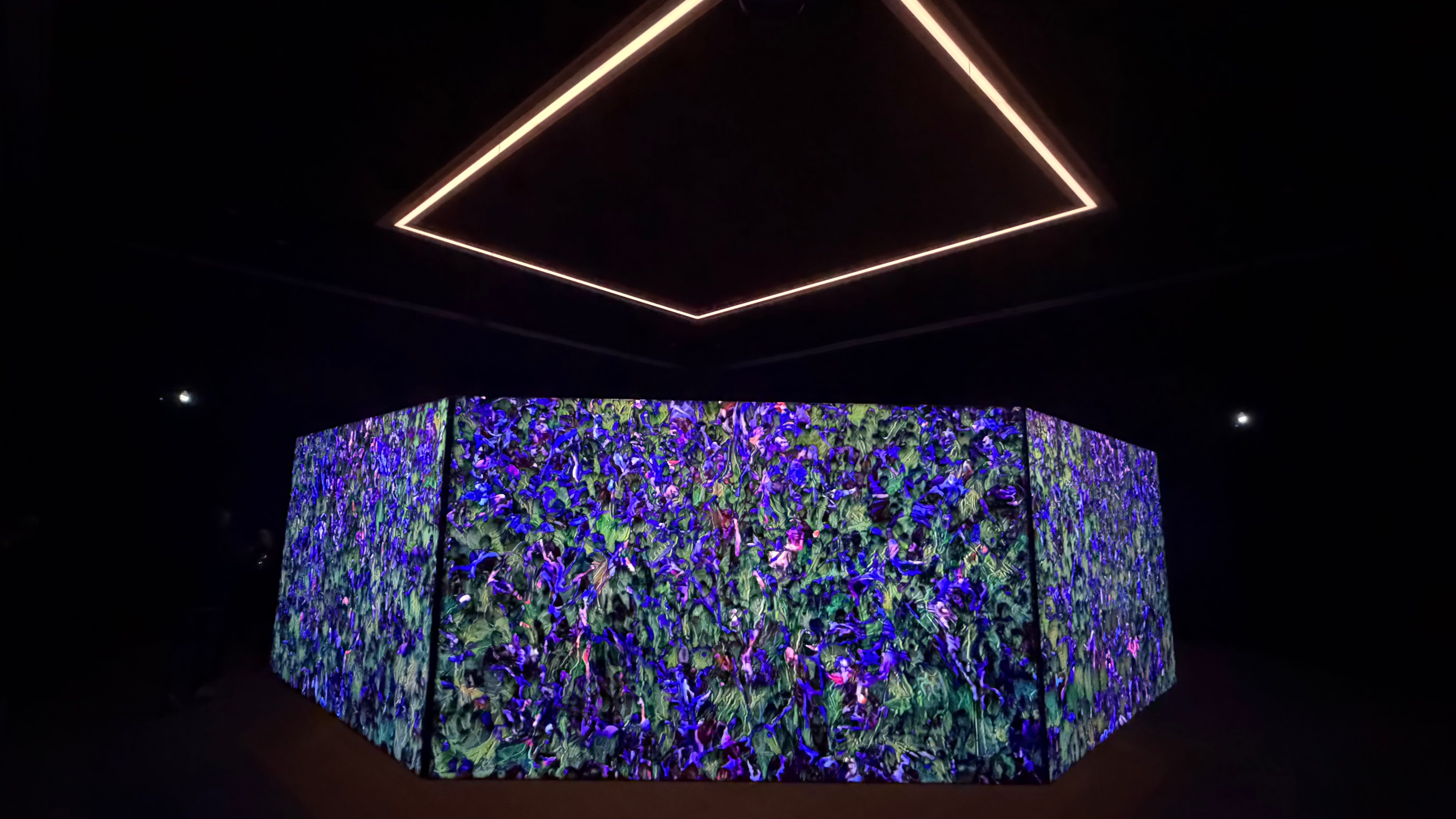
A dark room, a floating frame of light above, and a large glowing screen that moves slowly like a living painting. Sabsabi builds the work from the 12th-century Sufi poem by Farid ud-Din Attar, The Conference of the Birds. Painting, moving image and sound meet here to talk about spirituality, migration and our shared humanity. It also marks 72 years of Australia at the Biennale. A beautiful example that immersive art doesn’t always need to overwhelm our senses. Sometimes its power lies in giving us space to listen. We sat there much longer than we planned
And then there is Venice itself
Every Biennale we see art and technology grow closer, and this edition made us especially happy. Screens, game engines, sensors and sound systems are no longer a special corner; they are part of how many artists think. And the best part: all of this lives inside buildings that are hundreds of years old.
The strongest example for us was Taiwan.
Li Yi-Fan’s Screen Melancholy, curated by Raphael Fonseca, fills the Palazzo delle Prigioni, a 17th-century former prison just behind the Doge’s Palace. Under old chandeliers, a huge digital face shouts from a green screen. The artist scanned his own face, built his avatars in a game engine and used generative AI. Giant white fragments of heads and limbs lie on the stone floor, and some of them even charge your phone.
For anyone interested in the intersection of art and technology, this is a particularly relevant stop.


You can spend hours moving between exhibitions and discover something entirely different along the way.
And sometimes, the most memorable moment is simply stepping outside, crossing a bridge, finding a quiet canal, and remembering where you are.
Venice is already an extraordinary artistic experience. The Biennale adds another layer, bringing contemporary ideas into dialogue with centuries of human creativity.
And this dialogue is not only between old walls and new technology. Some other installations were built together with science:


Romania, with Anca Benera and Arnold Estefán, put sound at the centre for the first time in Black Seas – Scores for the Sonic Eye, reading the Black Sea as a fragile, closed ecosystem.
Venice‘s own pavilion, Note persistenti, uses generative sound systems and works made with H-Farm and Cisco.
Great Britain: Lubaina Himid’s Predicting History: Testing Translation pairs large paintings with a soundscape made with Magda Stawarska.
This is the most exciting signal: the future of art is not a choice between the old and the new. It is a conversation between them.
One last week to experience it
If you want to live all of this yourself, hurry: only one week is left. The 61st Biennale Arte closes on Sunday 22 November 2026. Until then, the Giardini and the Arsenale are open Tuesday to Sunday, 10 am to 6 pm.
Take an umbrella, take your time, and leave space for the small, minor-key moments. They are the ones you will remember. See you at the next Biennale.
Art doesn’t need to give us all the answers. Sometimes its greatest gift is making us ask questions we hadn’t imagined before.
See you at the next one.
With curiosity,
CODAME
Plan your visit: La Biennale di Venezia
Discover ARTEX: codame.com/artex