



There was a time when privacy meant closing the curtains. It was a simple technology, requiring little more than a window, a piece of fabric and the suspicion that somebody, somewhere, might be looking.
We have since developed considerably more sophisticated ways of being watched, and considerably more sophisticated ways of watching each other. Cameras, phones, sensors, browsers, social networks, cloud services and now AI systems have made the boundary between what is public and what is private increasingly difficult to see. Often we participate willingly. We click accept, upload the photograph, ask the question, share the location, give the application access. The technology works because we have agreed to let it into our lives, although we do not always know exactly what we have invited in.
At CODAME, we have been exploring these questions for years, often before we had the vocabulary we use today. Artists have a useful habit of arriving at difficult questions before the rest of us have decided that they are important.
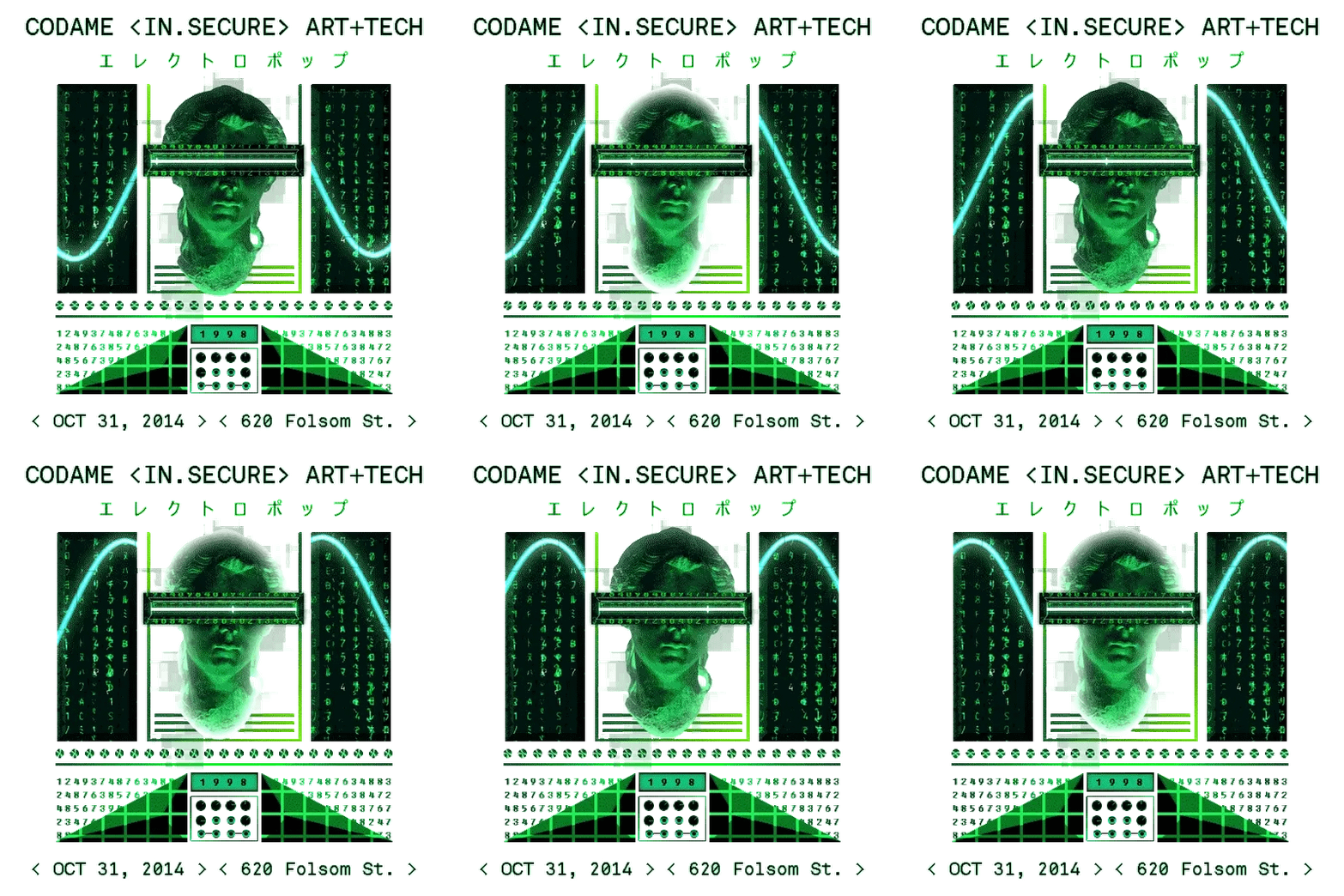
Back in 2014, our Security & Privacy ART+TECH Festival turned a San Francisco gallery into a playground for privacy, surveillance and cyberpunk culture. The language was playful, but the questions were serious. What happens when the technologies designed to protect us also become technologies that watch us? What happens when our bodies, identities and everyday behaviour become data?
A telephone booth became a passage into questions about military technology, public policy and state surveillance. Surveillance Phone, by Vivian Charlesworth and Alyson Ogasian, was designed as a kind of rabbit hole into an alternate reality, using science fiction to examine historical and contemporary questions around public policy and military-industrial development.
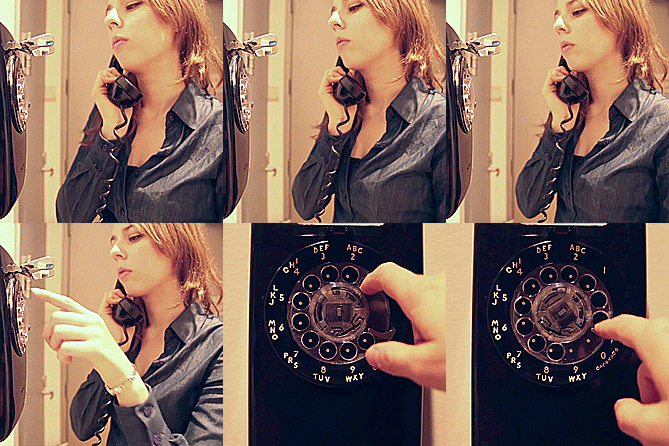
Cursor Watching turned the audience into observers of the data being extracted from our digital lives. The Faraday Cave went in the opposite direction: a small physical space where cellular signals and Wi-Fi disappeared, making privacy something you could actually experience rather than something described in a policy document.
Other works explored body scanning, autonomous drones and digital identity. They were playful, sometimes uncomfortable, and often deliberately ambiguous. That ambiguity was part of the point.
An artist does not necessarily need to tell us whether a technology is good or bad. Sometimes it is more interesting to make us experience it differently.
This is one of the things we continue to learn from the artists in our community. They take technologies that have become invisible through familiarity and make them visible again. A surveillance system becomes an artwork. A body scanner becomes a portrait. A drone becomes a game. An algorithm becomes something we can see, hear or touch.
And suddenly we start asking questions.
Who owns the data? Who gave permission? Who is watching? Who is being watched? What happens when the system gets it wrong?
With AI, these questions have become both more urgent and more complicated. Generative models are trained on enormous collections of human-created material, while new AI systems can generate images, text, music and code, make recommendations, interact with people and increasingly act through other software and services.
For artists, this brings very practical questions about copyright, consent, attribution and creative ownership. For organizations, there are questions about privacy, security, transparency, governance and responsibility. And for all of us there is the larger question of agency: when a machine can remember, infer, recommend and eventually act on our behalf, how much of the decision remains ours?
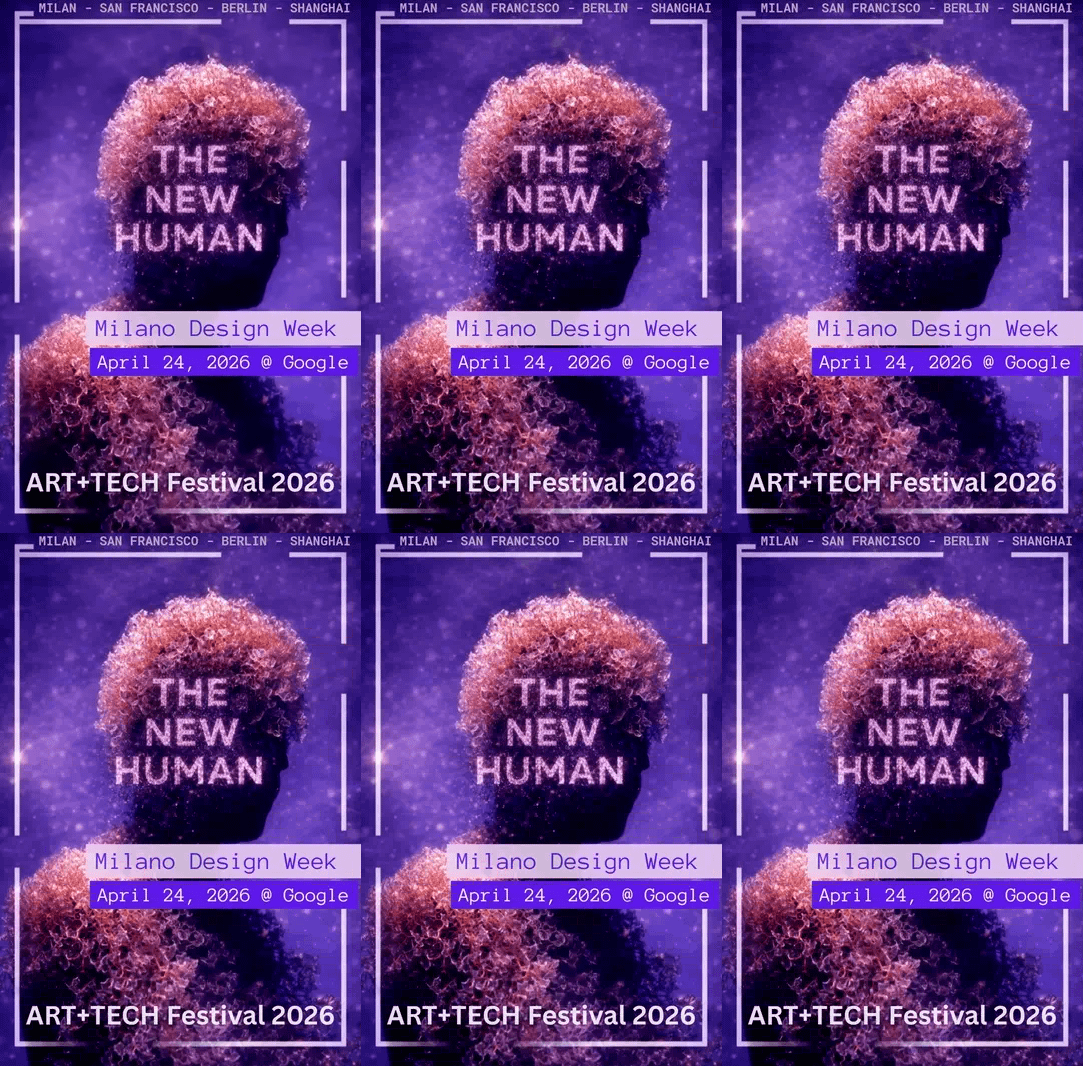
These questions are at the heart of what we have been exploring through The New Human, our 2026 ART+TECH theme. We asked what happens when cognition is shared between humans and machines, where thinking ends and authorship begins, and how we design for care and agency when everything is connected.
The questions are deliberately open. We are not particularly interested in predicting a single future. We are more interested in creating spaces where people can experience possible futures and decide what they think about them.
This is where compliance becomes an interesting word.
Compliance is necessary. Organizations need rules, controls, audits and frameworks. But being compliant does not automatically make something ethical. A system can follow the rules and still be invasive. Data can be legally acquired and still have been collected in a way that feels wrong to the people who created it. An AI system can behave exactly as designed and still produce consequences nobody intended.
The checklist can tell us whether we are allowed to do something. It cannot always tell us whether we should.
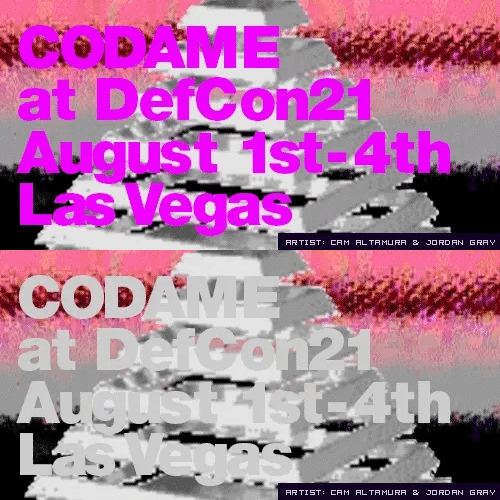
Perhaps this is why our connection with the hacker community has always felt so natural. Our participation around DEF CON in Las Vegas brought this back into focus. DEF CON is built around the idea that one of the best ways to understand a system is to take it apart, test its assumptions and find where it breaks. The AI Village brings that approach to artificial intelligence, exploring vulnerabilities, adversarial behaviour, bias and the ways AI systems can be manipulated.
Artists often do something surprisingly similar, although the language is different.
They misuse systems. They push interfaces beyond their intended purpose. They expose hidden behaviours. They take the assumptions built into a technology and turn them into something people can experience.
The hacker finds the vulnerability. The artist can sometimes make us understand why that vulnerability matters.
Both are forms of investigation.
This feels particularly important as AI moves from being something that generates an answer to something that can take action. An AI that writes a paragraph is one thing. An AI that can read our documents, access our systems, call other services, make decisions and change things in the world is something else entirely.
At that point, security and ethics stop being questions for a specialist team somewhere inside the organization. They become part of the design of the experience itself.
This is also part of what we are exploring through ARTEX. When we describe it as a new medium for living digital art, we are thinking about technology as something that can respond, evolve and interact rather than simply produce a fixed output. But the more responsive the technology becomes, the more important questions of agency, ownership and trust become.
We want artists to be able to experiment with AI without giving away ownership of their work by default. We want organizations to be able to explore new technologies without treating privacy and security as something to consider after the product has been built. And we want audiences to have the opportunity to experience these questions rather than only read about them.
Maybe that is one of the useful things that happens when art and technology meet.
Technology gives artists new materials with which to question the world. Art gives technology another way to be examined.
Not every experiment needs to produce an answer. Some are valuable simply because they make us notice something we had stopped seeing.
We have spent years looking at surveillance, privacy, security and identity through the work of artists. AI is now bringing all of those questions into a much larger conversation, and it is moving very quickly.
The vocabulary will continue to change. The regulations will change. The models will become more capable.
The questions underneath them probably won’t.
What do we give to machines?
What do we allow them to remember?
What should they be allowed to do?
And, perhaps most importantly, what should remain ours?